Phases already written for your discipline.
Seven design disciplines, each with a library of project phases, outcomes, and deliverable lists. Pick your discipline and the structure of the proposal is already in place.
How it works
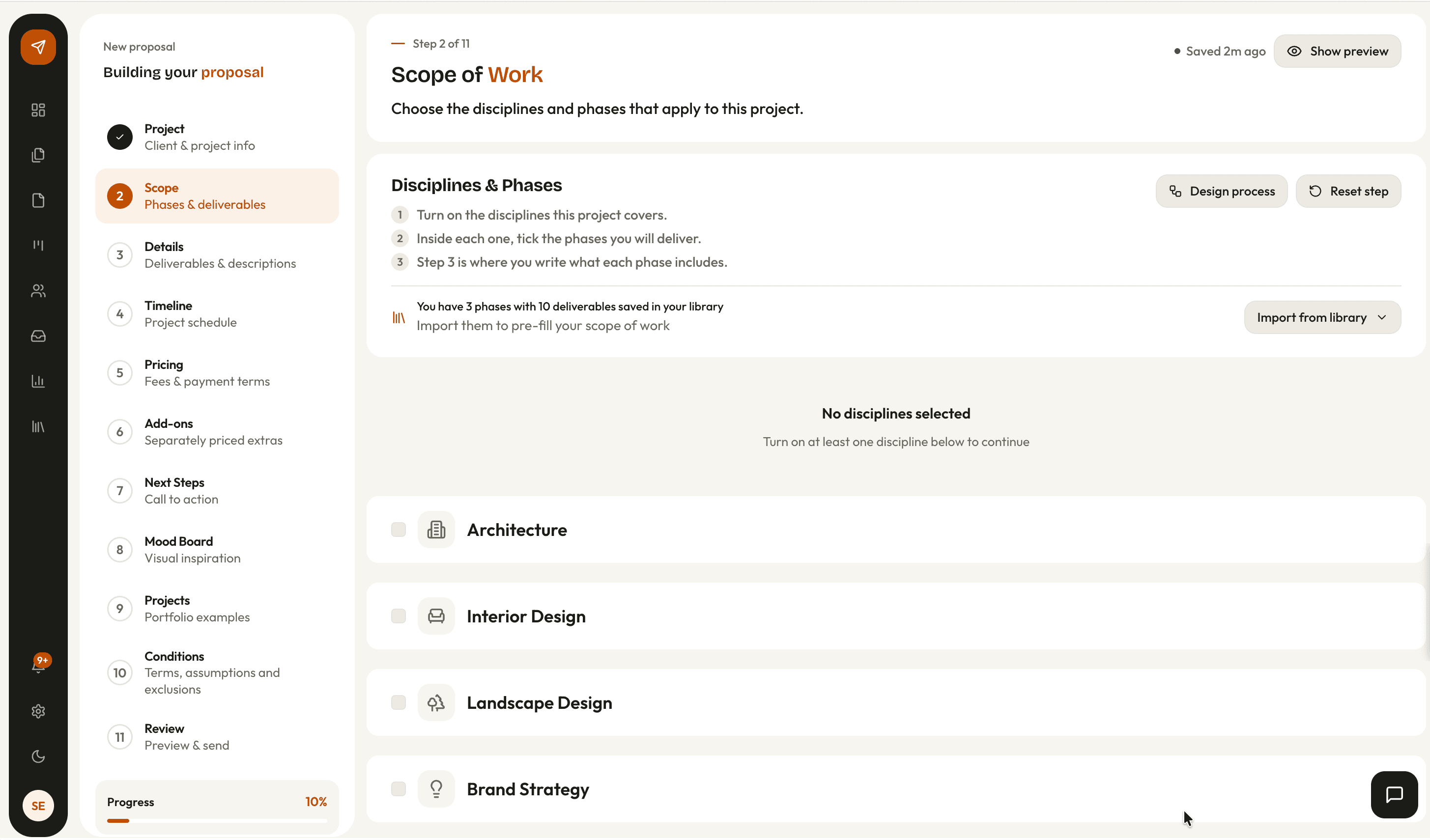
Pick the discipline
Seven are built in, and you can add your own. The choice loads that discipline’s phases, already named and ordered the way the work runs.
Choose the phases you are selling
Architecture ships eight, most other disciplines six. Deselect the ones outside this job, or add a phase the library does not have.
Set the depth
Every description exists in short, standard and detailed. A one-page quote and a tender document draw from the same library at different lengths.
Edit and keep
Change any name, description, outcome or deliverable. Save the version you prefer to your content library and the next proposal starts from that instead.
Seven libraries, forty-three phases
Each library follows how that discipline actually runs a project rather than a generic five-step process. Architecture carries eight phases through to closeout; visual design needs five.
- Architecture, from feasibility and site analysis to tender, construction administration and closeout
- Interior and landscape design, each available as design-only or design-build
- Brand strategy and brand identity kept separate, because they sell as different pieces of work
- Visual design and web design, from art direction through production and handoff
- Architecture
- 8 phases
- Interior Design
- 6 phases
- Landscape Design
- 6 phases
- Brand Strategy
- 6 phases
- Brand Identity
- 6 phases
- Visual Design
- 5 phases
- Web Design
- 6 phases
The same phase at three lengths
A phase is not one paragraph. It is a deliverables list, a process description with a stated outcome, and a long-form version for documents that have to stand on their own. All three are written, so changing depth is a toggle rather than a rewrite.
- Short gives the deliverables only, for a quote a client reads in two minutes
- Standard adds what happens in the phase and what is approved at the end of it
- Detailed explains each deliverable in its own paragraph, for tender and public-sector work
- Every phase carries an outcome line, so the client knows what they are signing off
Concept boards, space plans, material direction.
Spatial concepts and material direction developed into a plan you can react to.Outcome: an approved concept direction and layout.
The same phase written out for a tender document, with a paragraph per deliverable explaining what it is and why it matters.
A starting point, not a fixed set
The library is written so you have something to react to on a Tuesday afternoon. Nothing in it is locked, and the version you settle on is the one worth keeping.
- Rename phases, rewrite descriptions, add or remove deliverables
- Add a discipline of your own when none of the seven fits the work
- Save your edits to the content library so the next proposal starts from your wording
- Your written design process is used ahead of anything drafted for you
- Deliverables
- Per discipline and phase
- Past projects
- Case studies with imagery
- Next steps
- What happens after signing
- Terms & conditions
- Your standard clauses
- Assumptions & exclusions
- What the fee does not cover
- Design process
- Your methodology, per discipline
Where the phase copy comes from
| What changes | By hand | AirQuotes |
|---|---|---|
| Starting a scope | Open the last proposal and delete the parts that do not apply | Load the discipline and deselect what is out of scope |
| Phase descriptions | Rewritten from memory, differently each time | Written once per discipline, edited where the job differs |
| Deliverable lists | Whatever was in the document you copied | Held per phase, per discipline |
| Quote versus tender | Two documents maintained separately | One library at three depths |
| Outcomes | Often implied rather than stated | One line per phase saying what gets approved |
| Your own wording | Lives in whichever file you last got right | Saved to the library once and reused |
| A discipline you do not see | Write it from scratch | Add it as a custom discipline with your own phases |
Scroll the table sideways for the AirQuotes column.
What it does not do
It does not know your practice
The libraries describe how a discipline generally runs, not how you run it. The first proposal is where you correct that, and the corrections are what make the second one fast.
It is not a contract
Phase descriptions and outcomes are scope language, not legal terms. Your terms and conditions do that work, and they stay yours.
It does not price the phases
The library says what happens in a phase and what it produces. What that is worth is a judgement about your studio and this client.
Detailed is not always better
The long version exists for tender and public-sector work. Sending it to a private client who asked for a number makes the proposal harder to say yes to.
Asked before you ask
Which disciplines are built in?
Architecture, interior design, landscape design, brand strategy, brand identity, visual design and web design. Interior and landscape each run as design-only or design-build. If your work does not fit any of the seven, you can add a discipline of your own and write its phases.
How many phases are there?
Forty-three across the seven libraries. Architecture has eight, running through to post-occupancy evaluation and closeout. Interior, landscape, brand strategy, brand identity and web design have six each, and visual design has five.
What is the difference between the three depths?
Short is the deliverables list on its own. Standard adds two or three sentences on what happens in the phase plus the outcome it produces. Detailed opens with an overview paragraph and then explains each deliverable in turn, which is the version tender documents need.
Can I mix disciplines in one proposal?
Yes. A project that is genuinely both an interior fit-out and a brand rollout can carry phases from both libraries, and the timeline and payment schedule are built from whatever you selected.
Do my edits carry to the next proposal?
Only if you save them. Editing inside a proposal changes that proposal. Saving a phase description or deliverable list to the content library is what makes it the default next time.
Can I reorder or rename phases?
Yes, both. The names are labels on your scope, not keys the system depends on, so a phase can be called whatever your clients already call it.
See it on your next proposal.
Beta access is free for two months on the Studio plan. Applications are reviewed manually, and approved studios build their first proposal from their own brief.
Apply for beta →