How proposals convert, and why they don’t.
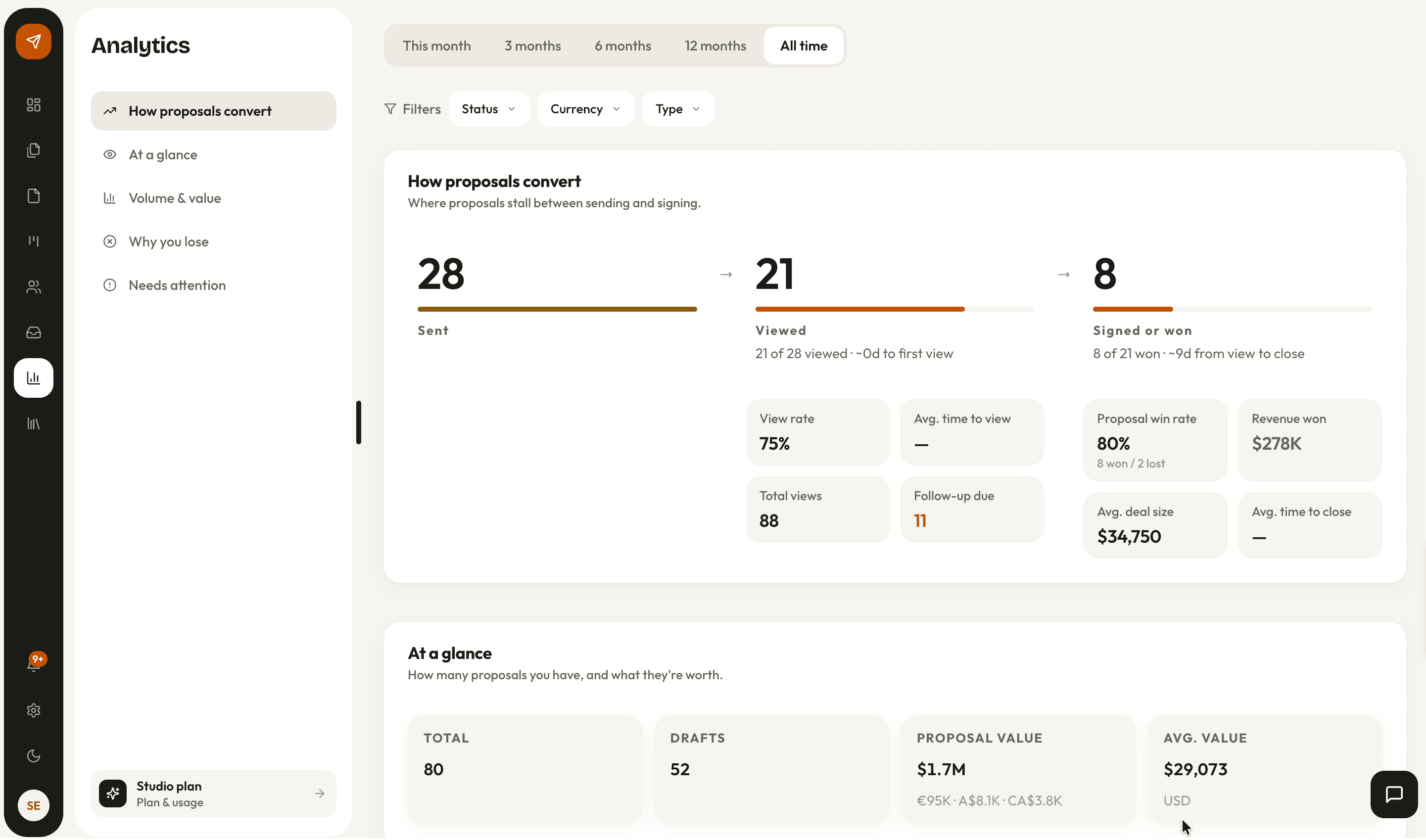
Win rate, average deal size, time to close, and revenue from won work, broken down by currency. When a proposal is lost, the recorded reason feeds a loss breakdown you can act on.
How it works
Send proposals
Everything here is built from proposals you actually sent, their engagement, and the outcome you recorded. Nothing needs entering twice.
Record the outcome
Mark a proposal won or lost. A lost one takes a reason, chosen from the list your studio keeps.
Read the period
Win rate, revenue won, average deal size, average time to first view and total views, over the range you choose.
Act on what needs attention
Follow-ups due, proposals sitting unviewed and expiring links surface together, with a drill-down to mark outcomes from there.
The funnel, and where it leaks
Sent, viewed, signed. Two numbers matter more than the headline: how many sent proposals were ever opened, and how many opened ones were ever decided.
- View rate as the share of sent proposals a client has opened
- Average days between sending and the first view
- Proposal win rate as won divided by decided, which excludes the ones still in the air
- A per-proposal timeline: created, sent, first viewed, signed, and the outcome you marked
- Sent24
- Viewed19
- Signed9
Why you lose, in your own words
Win rate tells you there is a problem. The loss breakdown is the only part that suggests what it is, and it is worth the ten seconds it takes to record a reason.
- Loss reasons are defined by your studio, not chosen from a fixed list
- The breakdown shows which reasons recur rather than which was most recent
- Revenue won is split by currency instead of blended at an invented rate
- Average deal size alongside it, so a good win rate on small jobs is visible as that
- Price5
- Timing3
- Went in-house2
- No response2
What needs attention this week
The most useful screen is not the one with the biggest numbers. It is the short list of proposals where doing nothing is currently the plan.
- Follow-up due: first opened three or more days ago, still no decision
- Sent but never opened, which is a different problem with a different fix
- Links approaching their expiry date while the deal is still live
- Mark won or lost from the list, without opening each proposal
- Investment214s
- Scope of work176s
- Timeline88s
- Terms61s
- Mood board24s
What you can answer afterwards
| What changes | Without it | AirQuotes |
|---|---|---|
| Win rate | A feeling, usually optimistic | Won divided by decided, for the period |
| Time to a decision | Unknown | Days from sent, to first view, to signed |
| Why deals were lost | Remembered for the recent ones | Recorded per proposal and counted |
| Which proposals stalled | Whichever you happen to think of | A list of opened-but-undecided |
| Never-opened proposals | Indistinguishable from rejections | Separated out |
| Revenue in two currencies | Converted, or reported wrong | Split by currency |
Scroll the table sideways for the AirQuotes column.
What it does not do
It only knows what you record
Proposals never marked won or lost sit outside the win rate entirely. The number is honest about that, which also means it is only as complete as your habits.
The follow-up threshold is fixed
Three days from the first view, the same for every studio. It is a prompt rather than a rule, and a project type with a long committee cycle will trip it early.
It does not explain the pattern
A loss breakdown weighted toward price might mean you are expensive, or that you are pitching the wrong clients. The chart cannot tell those apart.
Small numbers are noisy
A studio sending six proposals a quarter will see a win rate swing twenty points on one decision. Treat the trend across a year, not the figure this month.
Asked before you ask
How is win rate calculated?
Won proposals divided by decided proposals, meaning won plus lost, within the range you have selected. Proposals with no outcome recorded are excluded rather than counted as losses.
Why does it differ from the pipeline win rate?
This one counts proposals; the pipeline counts deals. One deal can carry several proposals, so the two answer different questions and will not match.
What counts as a follow-up due?
A proposal a client first opened at least three days ago that still has no decision recorded. The three-day threshold is fixed and applies to every studio.
Where do the loss reasons come from?
Your studio keeps its own list, so they use the language you actually use in a debrief rather than a generic set.
How is revenue reported when I quote in more than one currency?
Split by currency. There is no conversion, because a converted total is a number nobody can check against their accounts.
See it on your next proposal.
Beta access is free for two months on the Studio plan. Applications are reviewed manually, and approved studios build their first proposal from their own brief.
Apply for beta →